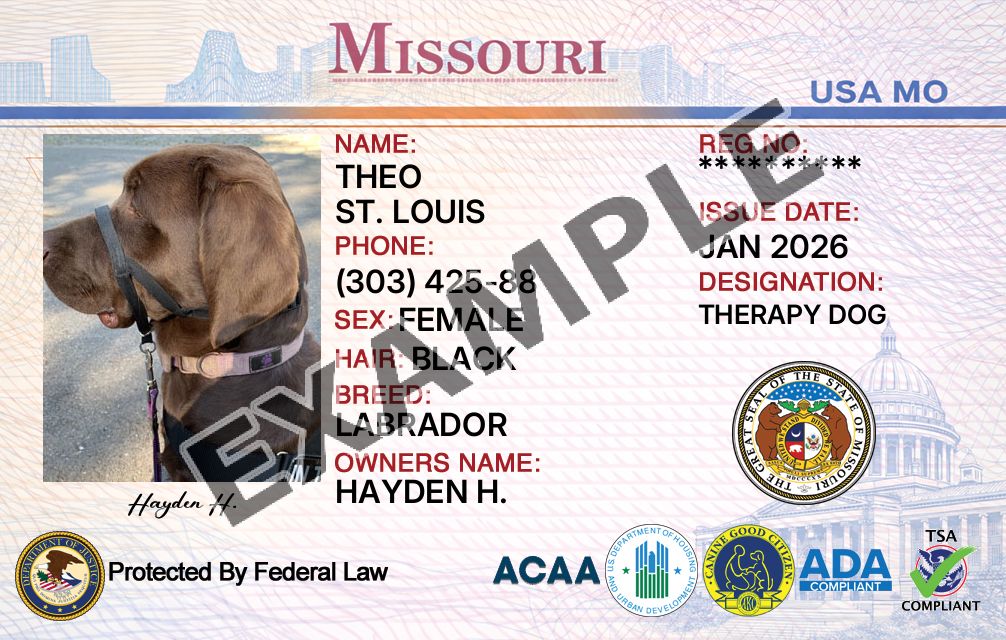
Registering a Dog in Carter County, Missouri (Including Service Dogs & Emotional Support Dogs)
If you’re asking where do I register my dog in Carter County, Missouri for my service dog or emotional support dog, the key thing to know is this: service dog status and emotional support animal (ESA) status are not created by a county dog license. A dog license in Carter County, Missouri (when required) is usually tied to local ordinances and rabies vaccination compliance—and is often handled by a city office (if you live inside city limits) or by a local enforcement/health office that supports rabies and animal control activities.
This page explains where to register a dog in Carter County, Missouri, what “registration” usually means locally, what documents you may need, and how this differs from service dog legal status and emotional support animal rules.
Important: Dog licensing is local, not a single “service dog registry”
In Missouri, there isn’t one universal countywide “service dog” or “emotional support dog” registration that makes a dog a service animal or ESA. Most “registration” questions in Carter County come down to local dog licensing/animal control rules and rabies vaccination documentation.
Where to Register or License Your Dog in Carter County, Missouri
Because animal ordinances and licensing are often handled at the city level, the right place to start depends on whether you live inside Van Buren, Grandin, or Ellsinore city limits versus in unincorporated Carter County. The offices below are examples of official local agencies and city halls that residents commonly contact about local ordinances, animal control questions, and rabies-related compliance.
City of Van Buren — City Hall
| Address | 1401 Main St., Van Buren, MO 63965 |
|---|---|
| Phone | (573) 323-4335 |
| Office Hours | Monday–Friday, 8:00 AM–4:30 PM |
Use City Hall if you live in Van Buren city limits and need to confirm whether a city dog license is required, how tags are issued, and what proof is accepted.
City of Grandin — City Hall
| Address | 308 5th St., Grandin, MO 63943 |
|---|---|
| Phone | (573) 593-4237 |
| Not publicly listed | |
| Office Hours | Not publicly listed |
If you reside in Grandin city limits, start here to confirm local licensing, leash, nuisance, and running-at-large rules.
City of Ellsinore — City Hall
| Address | 11 W Cleveland Ave, Ellsinore, MO 63937 |
|---|---|
| Phone | (573) 322-5333 |
| Not publicly listed | |
| Office Hours | Not publicly listed |
If you live in Ellsinore city limits, contact City Hall to ask whether you need a city license/tag and what rabies proof is required.
Carter County Health Center (Rabies Vaccination & Public Health Guidance)
| Address | 1611 Health Center Rd., Van Buren, MO 63965 |
|---|---|
| Phone | (573) 323-4413 |
| Fax | (573) 323-8489 |
| Office Hours | Not publicly listed (clinic hours vary) |
This office is a strong starting point for questions about rabies vaccination requirements, bite reporting, and what documentation local offices commonly accept as proof of current rabies vaccination.
Carter County Sheriff’s Office (Local Enforcement / Rural Areas)
| Mailing / Location | 1977 Cabin Drive, Suite 208, Van Buren, MO 63965 |
|---|---|
| Phone (24 hours) | (573) 323-4510 |
| Not publicly listed (site indicates an email contact link, but no address displayed) | |
| Administrative Office Hours | Monday–Friday, 8:00 AM–4:00 PM |
For residents in unincorporated Carter County, this office can help point you to the correct local process for animal complaints, running-at-large issues, and where local licensing questions are handled (if applicable in your specific location).
How to choose the right office
- Inside a city? Start with your City Hall (Van Buren, Grandin, or Ellsinore).
- Outside city limits? Start with the Carter County Sheriff’s Office for enforcement guidance and the Carter County Health Center for rabies documentation questions.
- Unsure which rules apply? Ask the office to confirm whether your address is in city limits and which ordinance or policy covers your area.
Overview of Dog Licensing in Carter County, Missouri
What people mean by “registering” a dog
In everyday terms, “registering” often means one of the following:
- Getting a local dog license (sometimes paired with a tag).
- Showing proof of current rabies vaccination to a local office.
- Complying with a local ordinance (leash law, limits on animals, nuisance rules).
- For service dogs/ESAs: asking how to “register” them—which is usually a misunderstanding, because legal status doesn’t come from a county registry.
Who typically administers a dog license in Carter County, Missouri
In many Missouri communities, licensing is handled by the city (for residents inside city limits), while county-level offices focus more on enforcement support, dispatch, public health, and general government functions. That’s why “animal control dog license Carter County, Missouri” searches often lead to local city halls and public health contacts rather than a single countywide licensing portal.
Why rabies compliance is central to local licensing
Even when the local process differs between towns, a common thread is that local authorities and public health agencies emphasize rabies vaccination of dogs as a key safety measure, especially because vaccinated pets help reduce risk from contact with rabid wildlife.
How Dog Licensing Works Locally in Carter County, Missouri
Step 1: Confirm whether you need a city license or another local registration
Start by confirming your jurisdiction:
- If you live in Van Buren, Grandin, or Ellsinore city limits, ask the city office whether a dog license in Carter County, Missouri is issued by the city and whether a tag is required to be worn on the dog’s collar.
- If you live outside city limits, ask local law enforcement and/or public health which ordinance or process applies for your address, and whether any licensing requirement exists through a local authority.
Step 2: Gather the documents local offices commonly request
When residents ask where to register a dog in Carter County, Missouri, the practical answer often includes “bring your rabies proof and ID.” While each office can set its own requirements, these items are commonly requested:
- Rabies vaccination proof (certificate or documentation from a veterinarian)
- Identification (driver’s license or other ID)
- Proof of residency (particularly for city licensing)
- Licensing fee (amount and payment method vary locally)
Step 3: Ask how renewals and updates are handled
Many local licensing programs (when they exist) are renewed on a schedule set by the city or local office—often annually. Ask:
- How long the license/tag is valid
- Whether a new rabies certificate is needed at renewal
- Whether the office updates records when you move within Carter County
What if you have a service dog or emotional support dog?
Your dog may still be subject to local rules that apply to all dogs (rabies vaccination, leash/running-at-large rules, nuisance rules). The difference is that service dog access rights are based on disability law and training to perform tasks, not on payment of a local license fee. Likewise, an emotional support animal generally does not gain public-access rights from a letter or “registration.”
Service Dog Laws in Carter County, Missouri
A service dog is defined by training and disability-related work/tasks
A true service dog is generally understood as a dog that is individually trained to do work or perform tasks for a person with a disability. The dog’s legal status comes from the handler’s disability-related need and the dog’s trained tasks—not from a paid “registration,” ID card, or vest.
Service dogs are not the same as a dog license
A local dog license (if required) is about animal control and public health compliance. It does not:
- Create service dog status
- Replace training requirements
- Grant public-access rights by itself
What businesses and the public can ask
In typical public-access situations, staff generally may ask limited questions to determine whether an animal is a service dog, but they should not require documentation as a condition of entry. If you’re unsure how this applies to your situation in Carter County, ask your local office for guidance on local enforcement concerns (for example, nuisance complaints), while understanding that public-access rules are grounded in broader disability law.
Local compliance still matters
Even with a service dog, you should still maintain:
- Current rabies vaccination documentation
- Good control of the dog in public
- Compliance with local leash and nuisance rules where applicable
Emotional Support Animal Rules in Carter County, Missouri
An ESA is not a service dog
An emotional support animal (sometimes called an “emotional support dog”) provides comfort by its presence, but it is not the same as a service dog trained to perform disability-related tasks. Because of that distinction, ESAs generally do not have the same public-access rights as service dogs.
There is no official county “ESA registration” that grants access rights
People searching for “animal control dog license Carter County, Missouri” sometimes believe a county license can double as ESA registration. In practice, a dog license (if required) is a local animal-control tool and does not establish ESA status.
Housing is where ESA documentation is most commonly used
ESA documentation most often comes up in housing contexts, where a housing provider may evaluate a request for an accommodation. If you’re seeking an accommodation, keep your request focused on housing rules and provide only the documentation required for that process. Separately, maintain any local licensing and rabies compliance required for all dogs in your area.
Your ESA may still need a local dog license
If your city requires a license/tag, your ESA typically follows the same local process as any other dog. That means you may still need to show rabies proof and pay any locally required licensing fee, even though that license does not make the dog an ESA.
Frequently Asked Questions
Reminder about scams and “instant registration” offers
If someone offers a paid “service dog registry” or “ESA registration” that promises legal rights, treat it with caution. For local licensing, rely on official offices listed above. For service dog and ESA questions, focus on the actual legal definitions and the specific setting (public access vs. housing).